The Laundromat –July Edition 2026


AMLR, AMLA, RTS, ITS: What’s Coming in 2027?AMLR, AMLA, RTS, ITS: What’s Coming in 2027?

In the July issue of The Laundromat, we take a closer look at the Anti-Money Laundering Authority (AMLA) and the regulatory framework it has been mandated to build.
- AMLA’s role: The European supervisory authority has been operational since 2025, tasked by the European Commission with defining the regulatory framework for the European Anti-Money Laundering Regulation (EU-AMLR).
- The open question: How far has this framework actually progressed, and where do gaps or ambiguities remain?
- The practical angle: What does this means for companies trying to meet their obligations efficiently and without unnecessary friction?
The Countdown to the EU AMLR is on – Regardless of the Details
The EU has set a firm deadline of July 10, 2027: By this date, all obligated companies must comply with the EU-AMLR requirements, and the expectation is clear: the systems and processes must be in place.
At the same time, the current status of the legally binding regulatory requirements and laws paints an almost familiar picture: Key technical standards and guidelines are still in the final stages of development, with the results of consultations being evaluated and incorporated into the regulatory framework. The regulatory framework is thus continuing to evolve, while the clock is ticking for those subjects to these requirements.
Anyone who waits for the final adoption of detailed regulatory provisions to become AMLR-ready will lose valuable time. This is because anti-money laundering supervisors will base their assessments on the substance of the regulations, not on the date of their final publication.
Compliance Readiness Requires Flexible, Adaptable Structures
Here’s where AMLR-bound companies should be investing now:
- robust governance models
- clean and usable data
- continuously refined risk approaches
- flexible KYC and KYB processes that can be integrated into a dynamic regulatory environment.
This means that EU AMLR readiness is not a matter of the timing of individual standards, but rather the ability to actively manage regulatory complexity. The focus must shift from reactively implementing individual requirements to building sustainable, adaptable structures with a clear rationale for compliance.
Managing Regulatory Complexity Proactively
The upcoming months will therefore be a critical phase for setting a strategic course to ensure the seamless integration of the three levels of the AMLA regulatory framework into systems and processes. These include:
- Regulatory Technical Standards (RTS): legally binding technical standards with detailed requirements for harmonized implementation
- Implementing Technical Standards (ITS): legally binding, with uniform formats, templates, processes, and technical specifications
- Guidelines: guidelines and recommendations – not legally binding, serving as interpretive aids and best practices for effective implementation.
And for companies, this means:
- Strategically: proactively managing regulatory complexity.
- Operationally: setting up controls and documentation in a modular and versionable way.
- Tactically: keeping open guidelines regarding scenarios, parameters, and monitoring under control.
A modular system architecture offers regulated companies better opportunities to prioritize the individual requirements of the AMLA based on their relevance and to incorporate them into their roadmap. The advantage is that, for example, data fields, roles, and escalation procedures become interchangeable building blocks that companies can use to respond flexibly to regulatory requirements that are specified in the future.
Identification methods form the basis for complying with EU AMLR obligations when implementing KYC and KYB procedures. eID and the EUDI Wallet are intended to be used as the preferred methods. WebID has therefore created the Identity Hub, an infrastructure that enables companies to design their identification ecosystem in a flexible and modular way.
An Overview of the Most Important Additions to the AMLR Rules and Regulations
| Type | Legal Basis | Main Focus | Status |
| ITS | AMLR 69(3) | Draft Implementing Technical Standards on the format for reporting suspicions and providing transaction records. | Consultation open |
| GL | AMLR 26(5) | Draft Guidelines on ongoing monitoring of business relationships. | Consultation open |
| GL | AMLR 10(4) | Draft Guidelines on business-wide risk assessment. | Consultation closed |
| RTS | AMLR 16(4) and 17(3) | Draft Regulatory Technical Standards on group-wide minimum requirements and additional measures for subsidiaries and branches in third countries. | Consultation closed |
| RTS | AMLR 28(1) | Draft Regulatory Technical Standards on Customer Due Diligence. | Consultation closed |
| RTS | AMLR 19(9) | Draft Regulatory Technical Standards on criteria for identifying business relationships, occasional and linked transactions and lower thresholds. | Consultation closed |
| ITS | AMLR 81(1) | Draft Implementing Technical Standards on FIU reporting to the EPPO. | Final report published |
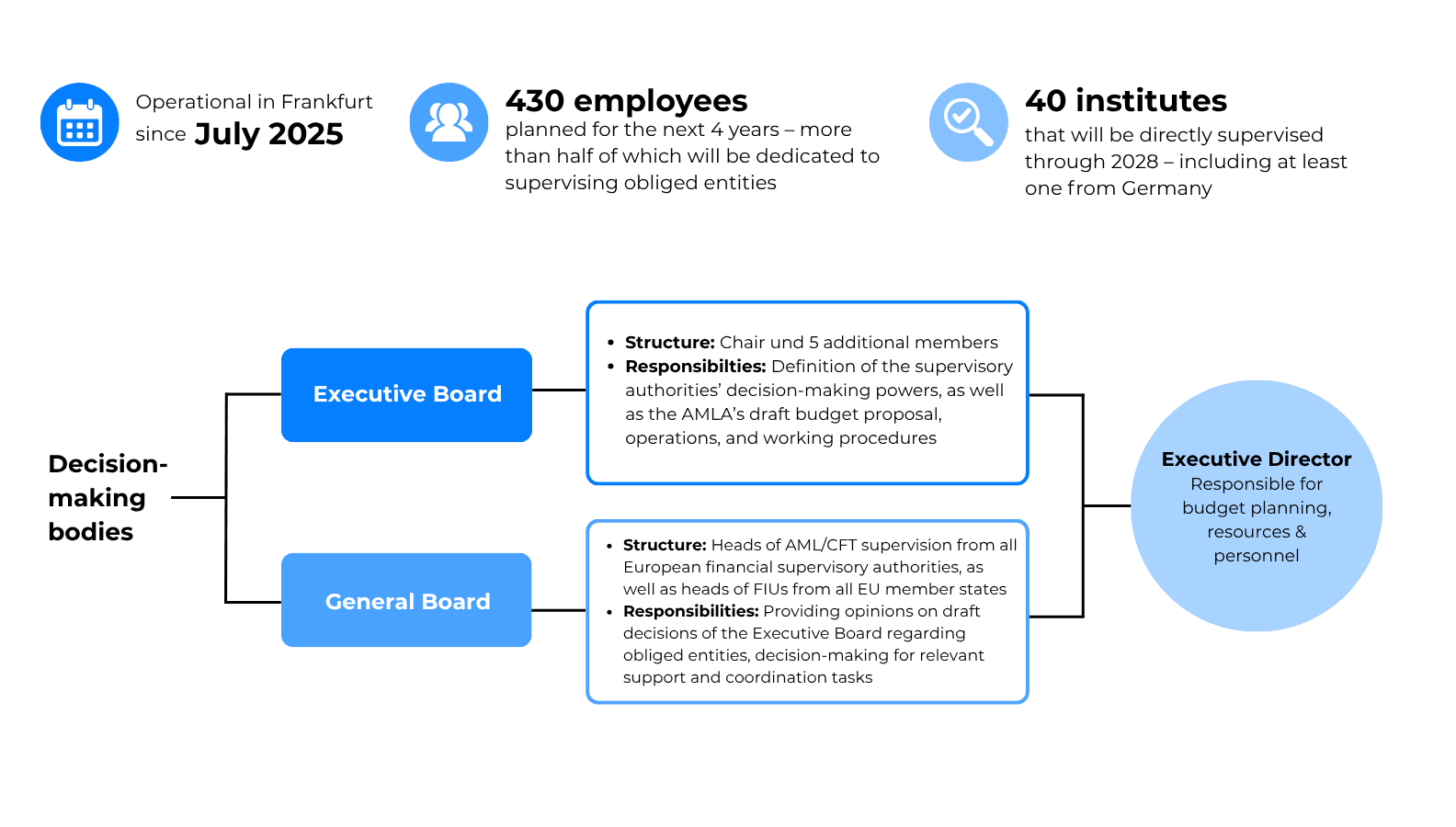
Facts About the Anti-Money Laundering Authority (AMLA)
The European Anti-Money Laundering Authority (AMLA) has been operating in Frankfurt for over a year now, working to implement the EU Anti-Money Laundering Regulation. It’s time to take a look at the key facts about the authority:
Further Reading
Questions and Answers About the EU AML Regulation
This article answers key questions regarding the EU AML Regulation, eIDAS 2.0, and the EUDI Wallet ecosystem.
AMLR Requirements at a Glance: What to Do Now
This article provides further information on the roadmap, requirements, and deadlines related to the EU AMLR.
AMLA Explained
What are the responsibilities of the Anti-Money Laundering Authority, and how does its work affect regulated entities?
Your Roadmap to AMLR Readiness
Discover how modern KYC and KYB solutions can help your organization prepare for the EU-AMLR and build a future proof compliance framework.